
The entrepreneur who wants to change the world with jute – Meet Else-Marie Malmek, founder of Juteborg Sweden AB
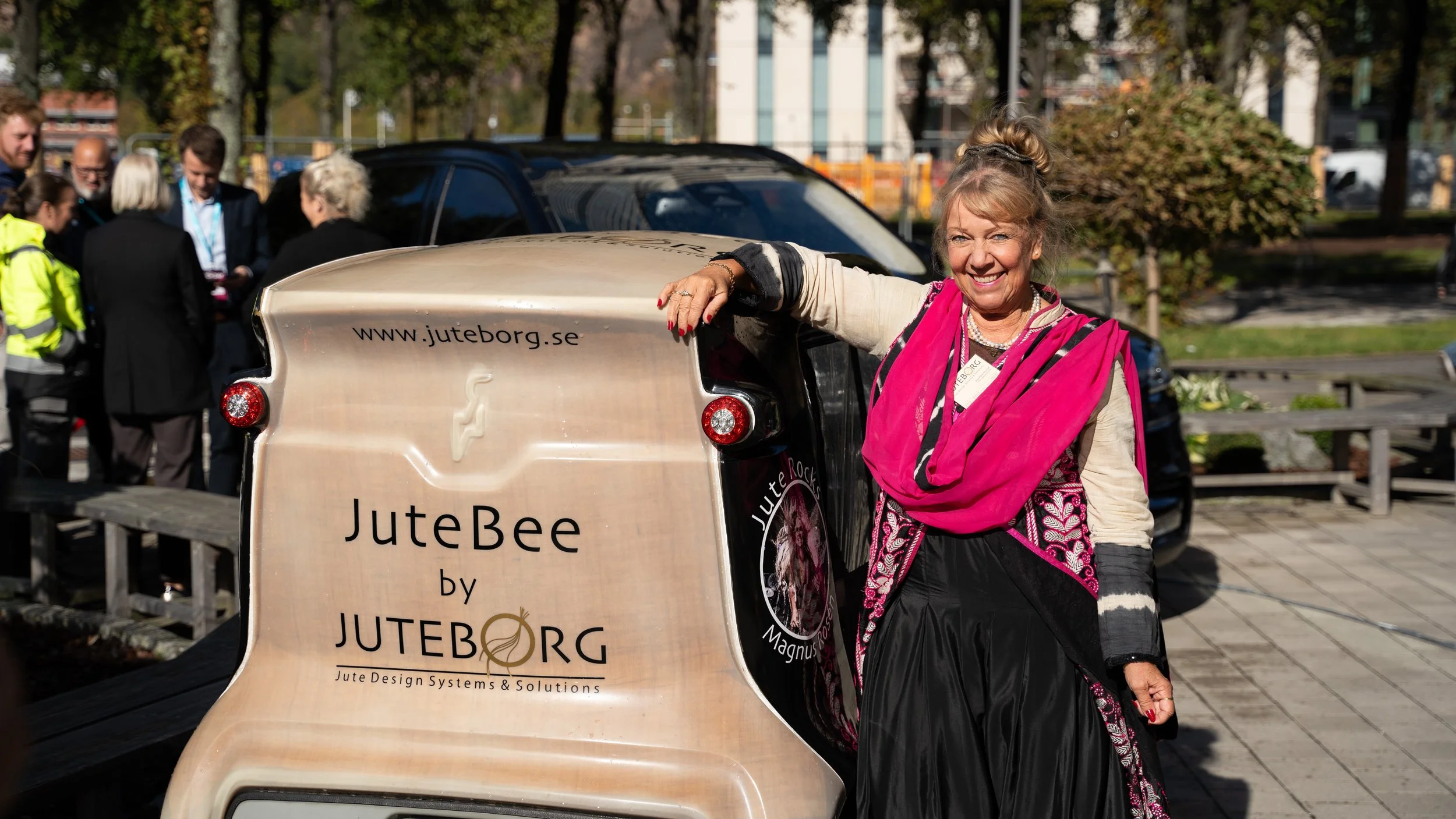
Else-Marie Malmek, founder of Juteborg Sweden AB, wants to make jute the obvious choice of material in the industry's transition.
Else-Marie Malmek describes herself as an innovator, intrapreneur, and entrepreneur, but above all as a person who is drawn to complex social and technical challenges where technology, sustainability, and human systems converge.
She is a trained systems scientist and spent over fifteen years at Volvo Cars, where she worked with systems and business development in purchasing and R&D. There, she learned how digitalization can streamline development processes while contributing to increased sustainability. She later became a change leader in the IT department with the official title of ‘IS/IT Idea Generator’, tasked with driving innovation at a time when the role of Innovation Manager did not yet exist.
I realized early on how closely digitization, mobility, and sustainability are linked—and what role IT and connected systems can play in creating entirely new business models.
The intrapreneurship that shaped everything
Back in 1996, Malmek developed the idea for The Network Concept Car – a concept that later laid the foundation for Sunfleet, Sweden's first major carpooling service.
That's when I realized I was an intrapreneur. That technology can change behaviors and systems, not just products.
At the same time, she learned an important lesson about the conditions for innovation:
– I thought everything would happen much faster. But innovations that require new materials and changes in human behavior take time. The right timing is crucial.
From system innovation to entrepreneurship
After 15 years at Volvo, Malmek took the leap into entrepreneurship. She first founded Malmeken AB and then Juteborg Sweden AB – both built on the same core principle: system understanding.
Juteborg has its origins in the SEVS project, an early FFI initiative in which industry, academia, and government agencies collaborated to explore sustainable mobility for the future. This deepened her understanding that certain societal challenges can never be solved by individual actors alone—they require systemic innovation.
When jute changed everything
In the early 2010s, Malmek came into contact with jute – and immediately saw its potential.
– Jute is a natural material with low climate impact, strong technical properties, and enormous social significance. It is exactly the type of lightweight material that industry needs.
– For me, the social dimension is not a side issue, but part of the system. Sustainable materials require sustainable value chains – all the way.
Together with an architect, she founded Juteborg with the ambition of building a circular material economy based on advanced jute technology, JuTech™.
Juteborg is both a materials and technology company, but also a system partner that helps industrial customers switch to more circular material choices as early as the design phase.
Today, Juteborg develops high-performance natural fiber composites that can replace glass fiber, plastic, and metal in everything from interior design details to more functional components in industries such as automotive, construction, interiors, packaging, and, increasingly, defense.
– We create value in several stages simultaneously. That is what makes jute unique.
Why jute – why now?
For Malmek, jute is not just a new material, but the right material at the right time. The automotive industry is facing a shift where circularity, recycling, and climate impact are no longer issues for the future—they are business requirements.
– The industry is undergoing a shift. New regulations and increased demands for circular design mean that material choices must be considered and made consciously as early as the design phase. This is no longer a discussion about the future. Material choices already determine competitiveness, cost, and compliance today.
At the same time, many of the materials that dominate today have limitations in terms of recycling, weight, and climate impact. Fiberglass is technically strong but difficult to recycle, while fossil-based plastic is lightweight but problematic from a sustainability perspective.
Jute offers an alternative that meets the industry's high technical requirements, while also contributing to lower weight, lower costs, and reduced climate impact. As reinforcement, jute can replace fiberglass and, in many applications, even heavier and more expensive fillers such as talc, while maintaining performance.
– Jute is biodegradable, requires neither irrigation nor artificial fertilizers, and has an extremely fast growth cycle. This makes the material unique – both from an environmental and industrial perspective.
She also emphasizes that sustainability does not have to be at odds with economics:
“Jute granulate challenges the notion that sustainable materials are more expensive. It is more cost-effective than glass fiber granulate right from the start and offers additional economic benefits over its entire life cycle.”
Deep tech for real
Developing new materials is a long and demanding journey. For Juteborg, research collaborations have been crucial, particularly with the University of Borås, but also with Chalmers University of Technology and RISE.
– The University of Borås is our extended R&D team. Without them, we would not be where we are today.
At the same time, Malmek points to structural challenges in the Swedish innovation system—especially for deep tech companies. Financing, IP protection, and support structures are often tailored to faster digital innovations, not to materials development with a 10–15-year time horizon.
– The expertise exists in Sweden. The challenge lies in the structures.
Financing – the major bottleneck
For Juteborg, financing is the most crucial issue.
We have verified technology and prototypes that meet industry requirements, but without revenue, we cannot invest in production equipment or take out global patents. The challenge is not the technology, but the step from verified innovation to industrial production.
She calls for a system where ideas and clear market needs can be met with the right support – faster and more flexibly than today.
The system, the ecosystem – and the future
Malmek describes the Swedish innovation system as competent but fragmented. There are many initiatives, but few unifying approaches—especially for materials and hard tech companies.
– Complexity can never be eliminated. It can only be managed.
Despite the challenges, her vision for the future is clear. She wants us in Sweden and the Western world to see jute, “The Golden Fiber,” as an obvious choice of material in a circular, global ecosystem.
– Jute is not the goal. It is the means. For transformation, sustainable design, and real systemic change.
